Project · SaaS directory
SaasTeaser
The SaaS directory that rates how sovereign your data is.
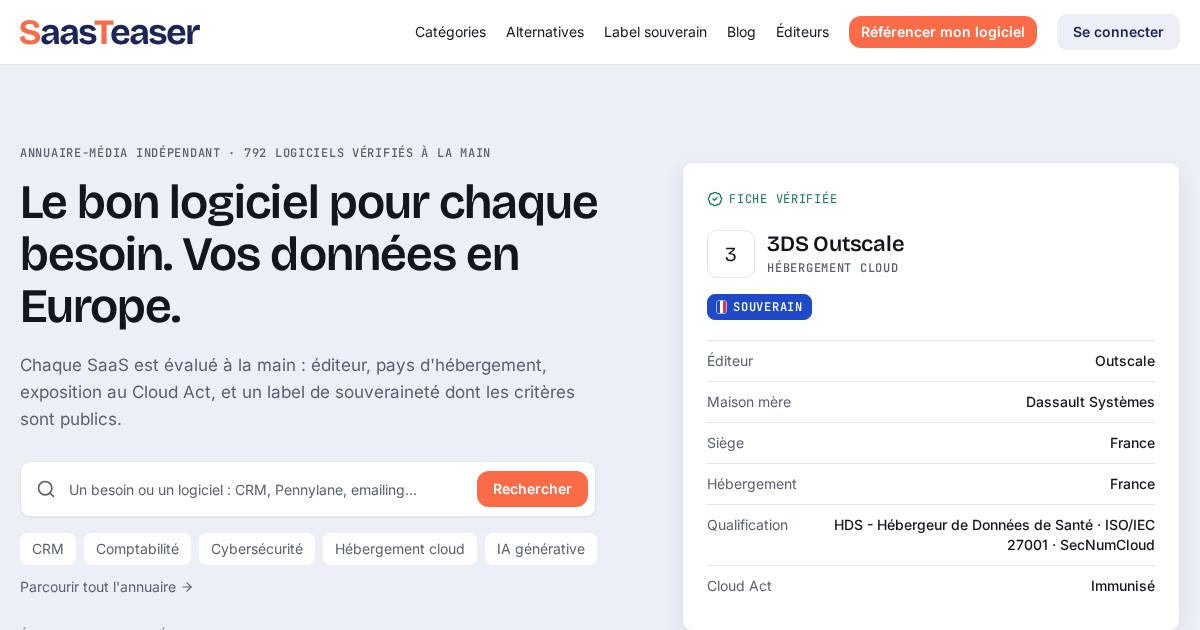
SaasTeaser is a French SaaS directory with an angle other directories ignore: data sovereignty. Every tool is rated on its exposure to the Cloud Act and other extraterritorial data-access laws, so you know who you're really trusting with your data before you choose.
- qualified SaaS listings
- 792
- alternatives pages
- 469
- subcategories
- 74
- sovereign (immune) tools
- 41%
The concept
I create and edit the listings myself to build a directory that's genuinely useful and well ranked. The project moves in three stages: first the editorial directory that draws traffic, then opening it up so vendors manage their own page, then a lead-generation layer for the tools listed. The site is live at saasteaser.com, in French first, with English and Spanish to follow.
The differentiator: sovereignty
A classic directory tells you what a tool does. SaasTeaser also tells you where your data goes. Every listing carries a sovereignty rating on three levels.
The directory brings together 792 qualified SaaS listings, 469 alternatives pages and 74 subcategories. 41% of the tools are immune.
- 325
Immune
European vendor and hosting, or a self-hostable open-source option.
- 241
Nuanced
Partial or conditional sovereignty: open source with a non-EU vendor, a local non-European tool, cases worth watching.
- 226
Exposed
Subject to extraterritorial law such as the Cloud Act, or its equivalent in other jurisdictions.
Of the 792 listings published, 325 are immune, 241 nuanced and 226 exposed.
Editorial thread
One theme comes up often on the blog: European and French tech gems that have passed under the control of US funds, from Talend to Pipedrive, by way of AT Internet (now Piano), Dataiku, Qlik, Teamtailor, Collibra and Sketchfab. Sovereignty isn't only about hosting, it's also about ownership.
- Talend
- Pipedrive
- AT Internet
- Piano
- Dataiku
- Qlik
- Teamtailor
- Collibra
- Sketchfab
The SEO / GEO approach
Search is built in from the start. The alternatives pages answer the question in the very first sentence, with a sovereignty comparison table, an FAQ and structured data, so they get picked up by Google and by generative answer engines alike. The blog handles comparisons and migration guides, the alternatives directory handles "alternative to X" queries, each in its own lane to avoid cannibalization.